Monday, January 21, 2008

Product check


I've recently been on the look out for a set of Timbale drums and came across these little gems at one of the Trade aid stores in Auckland. Although these drums are both small and are not traditional timbales, they pack a great sound and at only $20.00 each there a darn sight cheaper. So if your on the look out for ethnic style drums at a bargain price, then check out a Trade aid store near you at http://www.tradeaid.org.nz/

Tuesday, January 15, 2008

Welcome Page


Hi I'm Darren and Welcome to my Inner-Groove Percussion Blog page. Here you'll find useful tips on all things percussion ranging from playing techniques for a range of different hand-drums, through to product advise. Inner-groove percussion group offers private and group lessons in hand-drumming for the Djembe, Conga and Bongo drums. As well as tuition, IGP group can provide drum circle performances and group team-building sessions for corporate events. 'So grab a drum and bring out your Inner-groove'.

My interest in percussion started when I was still at school back in the U.K. I had a habit (and still do to this day) of constantly tapping on things like tables, chairs, you name it. At that stage though I never thought that I would develop a life-long interest in percussion. It wasn’t until I was in my mid twenties and I bought a set of Bongo drums and used to spend time jamming along to Ska, Reggae and Cuban music. It was then that I started to get more serious about wanting to become a percussionist.

Over the last eight years I have concentrated on studying the Djembe, Conga and Bongo drums and have played percussion in a number of Ska/Reggae bands as well as taking part in various drum-circle groups back in the U.K. One of the great things about being a percussionist is that it really is a life's work. There are some many other types of hand drums such as the Dombek drum, the Indian Tabla drum or the Irish Bohdran and that's before you start adding the smaller hand percussion instruments. Even after eight years I still haven't even scratch the surface.

So now I'm living on the beautiful Waiheke island off Auckland New Zealand. There are lots of musicians and hand-drummers on the island, and that's what prompted me to set up my own percussion group. So if its percussion your into then 'Watch this space'.

Friday, June 22, 2007

The modern Djembe drum.


Although the modern style Djembe drums may not look as ornate as the traditional ones, they are much easier and quicker to tune-up. Most of the modern djembes use a screwing nut tuning method. This is useful for two reasons, firstly it means that the drum can be tuned in a matter of minutes, and secondly it means that the drum can be de-tuned easily which in turn will help to preserve the drum skin as they can have a tendency to split if they are kept tightly tuned for long periods of time.

The moral is 'Shop around', don't feal as if you have to buy the most expensive drum straight away. Perhaps start with a basic modern style small djembe like the one shown here. Then, as your experience and interest in drumming develops, you can branch out for the more expensive traditional drum.

Happy Shopping.

Djembe - The traditional Djembe drum


Before you go out and purchase your first Djembe drum, consider the type of drum you want and how you intend to use it. The traditional West African drums are hand carved and use a rope tuning method. The traditional djembes create a warm sound as well as a sense of authenticity in playing 'The real deal' djembe drum. However, their are certain draw backs. The robe tuning method can be a timely procedure. Traditional drums can also be very expensive and if the skin splits, it can be both difficult and costly to find someone who knows how to re-skin and re-tune the drum.

Monday, June 11, 2007

Djembe Slap Tone

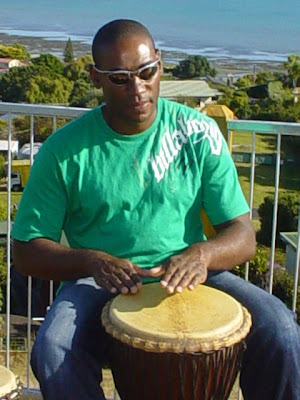
When playing the slap tone. Remember to hit the drum using the tips of your fingers, keeping your hand relaxed and your fingers slightly apart.

Djembe Open Tone.

When playing the open tone, remember to hit the drum with the lower part of your fingers. Keep your hand relaxed.

Djembe Bass Tone.

When playing the bass tone, remember to hit the drum with the palm of your hand keeping your fingers together. Remember to keep your hand relaxed.